



What is a booking engine? (And how 2026 changes everything)
By 2027, travelers will book hotels by asking AI assistants like ChatGPT or Google's Gemini—without ever visiting your website. This isn’t the far-off future; it’s a near reality. You need to start preparing now to ensure your booking engine will be part of the conversation.
A booking engine is your property's 24/7 digital sales representative. This software, embedded in your website, allows guests to check availability, compare rates, select rooms, and complete reservations themselves. Think of it as the technology that transforms lookers into bookers while keeping every dollar of revenue in your pocket.
Yet, while most hoteliers understand what a booking engine does today, few are prepared for what's coming tomorrow. The hospitality landscape is experiencing its most significant transformation since the Online Travel Agency (OTA) disruption of the early 2000s. This time, the catalyst is artificial intelligence (AI)—and the stakes are even higher.
This article explores what booking engines are and what they’re becoming. We'll examine why every property needs one, reveal the future trends reshaping the industry through 2027, and show how integrated systems can position your property to thrive in this new era. Whether you're evaluating your first booking engine or reconsidering your current solution, understanding these shifts isn't optional—it's survival.
TLDR
- Booking engines are evolving from simple reservation tools into AI-ready infrastructure.
- By 2027, Google's Gemini and other AI assistants will handle most hotel bookings through conversation, not clicks.
- Properties with real-time APIs, structured data, and instant payment capabilities will appear in AI recommendations—those without simply won't exist in the new landscape.
- The window to prepare is 12-18 months.
- This guide covers what's changing, why it matters, and how to future-proof your booking technology now.
Why every property needs a booking engine
Modern travelers expect the convenience of instant booking, transparent pricing, and the ability to complete transactions on their own schedule. Without a booking engine on your website, you're essentially hanging a "Closed" sign on your most valuable sales channel.
The numbers are compelling. OTAs typically charge 15-25% commission on every booking, while payment processing fees for direct bookings run just 2-3%. For a 50-room property averaging $150 per night with 70% occupancy, shifting even half your bookings from OTAs to direct channels would realize massive savings annually. And that’s money flowing straight to your bottom line rather than enriching intermediate channels.
Beyond the financial impact, direct bookings give you something even more valuable: control. When guests book through your website, you own the relationship from the first click through checkout and beyond. You capture their contact information, understand their preferences, and can communicate directly without OTA intermediaries filtering your message. This connection enables targeted remarketing, personalized experiences, and the kind of relationship building that transforms one-time visitors into loyal repeat guests.
The direct booking channel also delivers superior margins because you control the entire guest journey. You can upsell premium rooms, promote packages, cross-sell spa treatments, or restaurant reservations, and encourage add-ons that boost your average transaction value. Properties like Bendooley Estate have leveraged their booking engines to create seamless experiences that combine accommodations with unique offerings like vineyard tours or culinary experiences. These are revenue opportunities that simply don't exist when guests book through third-party platforms.
Furthermore, today's booking engines integrate smoothly with your property management system (PMS), creating operational efficiencies that reduce manual work and eliminate double-booking risks. When a reservation comes through your website, it flows automatically into your PMS, updating availability across all channels in real time. This synchronization is foundational—not just for today's operations but for the AI-powered future rapidly approaching.
The imperative to invest in a robust booking engine has never been stronger. Properties that build their direct booking infrastructure now will be positioned to capitalize on the seismic shifts ahead, while those that delay risk becoming invisible in an AI-first booking landscape.
Understanding why booking engines matter sets the stage for appreciating how dramatically they're about to evolve. The capabilities that separate winners from losers in 2027 look fundamentally different from what defined success in 2024.
The future of booking engines (2025-2027)
The booking engine you implement today will face a dramatically different marketplace within 24 months. Understanding these emerging trends is essential—it's about ensuring your technology investments don't become obsolete before they deliver ROI.
Google's agentic booking revolution
In late 2025, Google announced a feature that will fundamentally alter how people discover and book hotels. Rather than clicking through to hotel websites or OTA listings, travelers will soon complete entire reservations by simply conversing with Google's Gemini AI assistant.
Here's how it works: A businesswoman planning a weekend away asks Gemini, "Find me a pet-friendly hotel in Charleston for next weekend under $200 per night." Instead of returning a list of links, Gemini searches real-time availability, compares options based on the specific criteria, and presents personalized recommendations—complete with pricing, photos, and reviews. When the traveler says, "Book the second option," Gemini handles the entire transaction, including payment processing.
Google isn't becoming a merchant of record or OTA competitor. Instead, they've partnered with major booking platforms including Booking.com, Expedia, Marriott, IHG, Choice Hotels, and Wyndham. The business model mirrors current Google Hotel Ads: participating properties pay either CPC (cost-per-click) fees when people engage with their listings or commission on completed bookings.
The critical difference is compression of the booking funnel. Previously, a guest might have visited 5-7 websites, compared prices across multiple platforms, read dozens of reviews, and spent 20-30 minutes completing a booking. Agentic booking collapses this entire journey into a single conversation lasting 2-3 minutes.
For hoteliers, this presents both opportunity and existential threat. Properties with robust structured data, real-time API connections, and machine-readable content will be surfaced in AI recommendations. Those without these capabilities simply won't appear—not because they're on page two of search results, but because they literally don't exist in the AI's consideration set.
The rollout is happening now. Expect broader availability throughout 2026, with mainstream adoption likely by early 2027. The window to prepare is narrow.
AI search optimization and structured data requirements
If traditional SEO focused on ranking for human searches on Google, the emerging discipline of Answer engine optimization (AEO) is about ensuring AI assistants can find, understand, and recommend your property. This agent-focused optimization demands a fundamentally different approach to how you present information online. AI agents don't browse websites the way humans do—they parse structured data, looking for specific signals that indicate relevance, credibility, and ability to make a booking.
Beyond schema markup, your booking engine needs API-first architecture that delivers instant data responses. When ChatGPT or Claude asks, "Does this hotel have availability for two queen rooms on March 15th?", your system must respond immediately with accurate information. Stale data or delayed responses mean AI agents will simply move on to properties that can answer in real time.
The Model Context Protocol (MCP), introduced by Anthropic in late 2024 and quickly adopted by OpenAI, Microsoft, and Google, is becoming the universal standard for AI-to-business connections. Think of MCP as a universal translator—a single integration that allows any AI assistant (ChatGPT, Claude, Gemini, Alexa) to connect with your booking system, eliminating the need to build separate integrations for each platform.
Properties that build MCP servers (or work with technology vendors implementing MCP) gain a critical advantage: seamless booking across all major AI platforms through one integration. Hotels that skip this step will need separate integrations for ChatGPT, Claude, Gemini, Alexa, and every emerging AI assistant—a technical and financial burden few can sustain.
The first direct MCP bookings are expected by late 2026. Early adopters will benefit from lower implementation costs and more refined systems by the time mainstream adoption arrives. Critically, if OTAs dominate MCP connectivity while independent hotels lag behind, we'll face a new wave of intermediation more powerful than the original OTA disruption.

Payment evolution: instant transfers and frictionless transactions
The way guests pay for hotel stays is evolving as rapidly as how they discover and book them. Regulatory changes and technological advancement are converging to create new payment experiences that eliminate friction, reduce costs, and accelerate cash flow.
In the European Union, new regulations mandate several changes affecting hotel booking engines. Meanwhile in the United States, the Federal Reserve's FedNow service and The Clearing House's Real-Time Payments (RTP) network are driving similar transformation without regulatory mandate.
For hotels, instant payments mean improved cash flow—critical for properties operating on tight margins. Rather than waiting days for card settlements or dealing with chargebacks, account-to-account transfers move money immediately with minimal fees. The cost difference is substantial: credit card processing typically costs 2-3% plus transaction fees, while instant bank transfers cost pennies regardless of transaction size.
The breakthrough innovation is Request for Payment (RFP), a new standard that allows businesses to send payment requests directly to customers' banking apps. Imagine sending a reservation confirmation that includes a clickable payment request. The guest taps it, their banking app opens with pre-filled details, they authenticate with a fingerprint or face scan, and payment completes in seconds. No card numbers, no expiry dates, no CVV codes—just instant, secure, low-cost transfer.
What hoteliers should do now: If you operate in Europe, start conversations with your payment processor about their compliance roadmap and implementation timeline. Ask specifically about instant payment support, enhanced authentication methods, and refund processing capabilities. For US properties, verify whether your payment gateway supports FedNow or RTP—even if you don't activate these features immediately, you want the infrastructure ready when guest demand increases and competitors begin offering instant payment options.
Cloud-native booking engines like RMS are building these capabilities now, positioning their hotel clients to capitalize on payment modernization as it scales. Legacy systems that rely solely on credit card processing will face increasing pressure as both guests and properties demand faster, cheaper alternatives.
Metasearch evolution and AI-powered personalization
Metasearch platforms—primarily Google Hotel Ads, along with TripAdvisor and Trivago—have matured from simple price comparison tools into sophisticated distribution channels. Many hotels now allocate a high percentage of their paid search spending to metasearch advertising. Metasearch has evolved from supplementary channel to primary discovery engine. For booking engines, metasearch integration isn't optional—it's the pipeline feeding your highest-intent traffic.
The next evolution is already underway: AI-powered personalization that considers a guest's entire search history, previous bookings, stated preferences, and behavioral patterns to surface hyper-relevant recommendations. Rather than showing generic results ranked primarily by bid price, metasearch engines are learning which properties specific travelers prefer and adjusting display accordingly.
This means two guests searching identical dates and locations will see different results based on their individual profiles. The business traveler who consistently books hotels near convention centers with fitness facilities sees those properties prominently. The family traveling with kids sees properties highlighting pools and suites. Budget-conscious guests see value options first, while luxury travelers see premium properties.
For hoteliers, success in this AI-enhanced metasearch environment requires three things.
Rich, accurate property data: Detailed amenity information, high-quality photos, specific room descriptions, and authentic guest reviews give AI systems the signals they need to match your property with appropriate travelers.
Strategic bidding: Understanding which guest segments deliver the highest value and adjusting bids to reach them more effectively while reducing spend on lower-value traffic.
Conversion optimization: Ensuring that when guests click through from metasearch to your booking engine, they find exactly what was promised and experience a seamless booking flow.
The integration between metasearch platforms and booking engines is becoming more sophisticated. Real-time bidding adjustments based on current occupancy, dynamic rate loading tied to PMS availability, and automated budget allocation across different guest segments are all emerging capabilities that separate leaders from laggards.
As voice search integration expands (see next section), metasearch results will also feed AI assistants, making metasearch visibility doubly important. Properties that don't appear in metasearch results may also be invisible to voice and AI search.

Voice search and conversational booking
Voice-activated booking is moving from novelty to mainstream faster than many anticipated. The partnership between Alexa+ and Expedia, launched in 2026, enables people to search for hotels, compare options, and complete bookings entirely through voice commands—with payment details stored securely in their Amazon account.
Almost 30% of people using the Internet in the USA use voice assistants each week* and industry analysts project that 15-20% of all travel searches will be voice-activated by the end of 2026. Busy professionals multitasking during commutes, families juggling multiple schedules, and accessibility-focused travelers find voice interfaces easier than typing.
Beyond consumer-facing applications, in-room voice assistants are becoming standard in upscale properties. Guests can now use voice commands to adjust room temperature, request housekeeping, order room service, book spa appointments, or extend their stay. These systems integrate directly with the PMS, creating seamless experiences while capturing valuable data about guest preferences.
For booking engines, voice compatibility means optimizing for natural language queries rather than keyword strings. When someone asks, "Find me a hotel near the Space Needle with parking and breakfast included," your system needs to understand intent, parse the requirements, and respond with relevant options—all through conversational language rather than search filters and form fields.
The technical requirements overlap significantly with AI search optimization: structured data that clearly defines amenities, natural language descriptions of rooms and features, and real-time availability via APIs. Properties investing in these capabilities for AI search automatically become voice-search-ready.
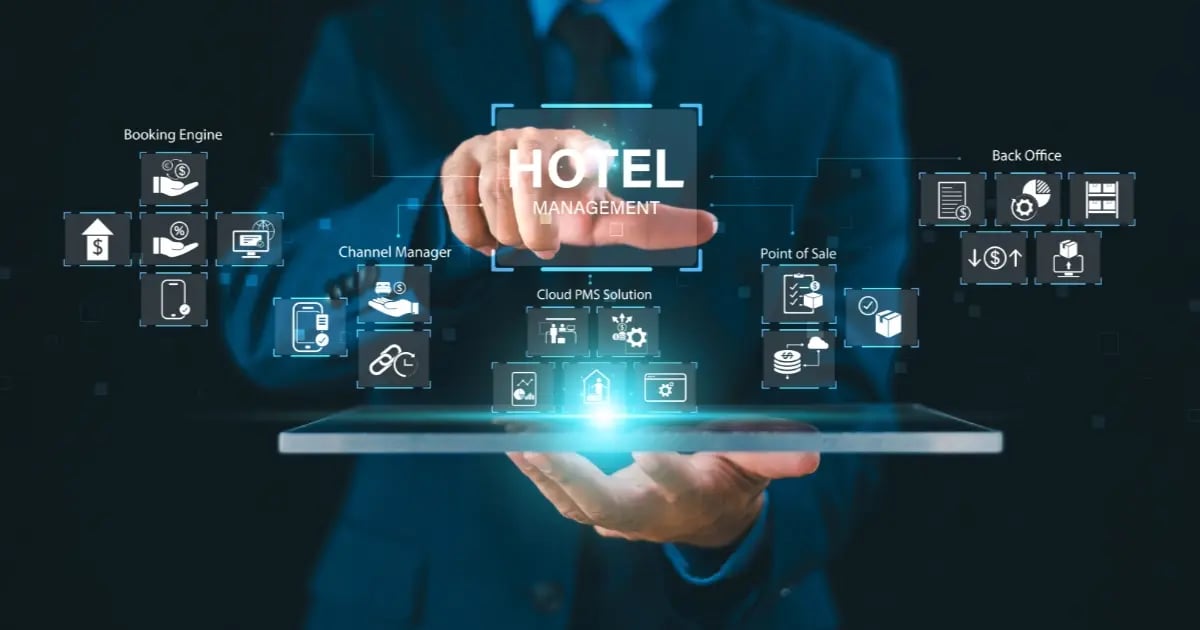
These emerging capabilities—agentic booking, AI search, instant payments, metasearch visibility, and voice interaction—share a common requirement: seamless integration across your technology ecosystem. Booking engines can no longer operate as standalone tools.
How integrated systems future-proof your property
The consistent thread through every trend we've examined is integration. Booking engines must connect seamlessly with your PMS, channel manager, revenue management system, payment processor, and emerging AI platforms.
This integration delivers compound benefits that extend far beyond operational convenience. When your booking engine shares real-time data with your PMS, every reservation instantly updates availability across all channels, eliminating double-bookings and reducing manual reconciliation work. When it connects to your revenue management system, rates adjust automatically based on demand forecasts, competitor pricing, and inventory levels—maximizing revenue without constant manual intervention.
Consider a practical example: A couple books your last suite through your website at 2:47 PM. Within seconds, that suite disappears from Booking.com, Expedia, and Google Hotel Ads. Without real-time integration, you'd risk a double-booking when an OTA guest attempts to reserve the same suite at 2:52 PM—a scenario that costs both money and reputation. Integrated systems eliminate this risk entirely.
True integration means building on a unified data model where information flows bidirectionally between systems. A guest books a spa package along with their room through your booking engine, and the PMS automatically schedules the appointment, notifies the spa, updates the guest folio, and adjusts inventory. When the guest checks in using a mobile key, the system confirms their identity, activates room access, and can even adjust HVAC to their preferred temperature if they're a returning guest.
Cloud-native platforms offer distinct advantages in this integrated ecosystem. Because they're built from the ground up for multi-system connectivity, they handle APIs, webhooks, and data synchronization more elegantly than legacy systems retrofitted with integration layers. RMS, for instance, provides booking engine functionality as an integral component of its cloud platform rather than a bolt-on module, ensuring tight integration without the complexity and failure points that plague pieced-together technology stacks.
This architectural approach becomes critical as AI platforms multiply. Rather than building individual integrations for ChatGPT, Claude, Gemini, Alexa, and whatever emerges next, integrated systems can implement once (via standards like MCP) and support multiple AI agents through a single interface. The operational efficiency and cost savings compound over time.
Integration also future proofs your data strategy. As AI personalization becomes more sophisticated, the properties that own comprehensive guest data—booking history, preferences, special requests, feedback, and behavioral patterns—can deliver superior experiences and command premium rates. Fragmented systems that trap data in silos simply can't compete.
The window for strategic implementation is narrowing. With Google's agentic booking rolling out through 2026 and European payment compliance required by mid-2027, properties implementing booking engines today have roughly 12-18 months to test, optimize, and establish their AI presence before the competitive landscape fundamentally shifts. The decisions you make now will determine whether you lead or lag in this transformation.

Implementing a booking engine that prepares you for tomorrow
Selecting and implementing a booking engine is a decision with multi-year consequences. Making the wrong choice means living with limitations during the most transformative period in hospitality technology or facing expensive and disruptive replacement projects. Making the right choice positions your property to capitalize on every opportunity ahead.
Here's a practical framework for ensuring your booking engine investment delivers both immediate value and long-term flexibility:
Evaluate technical architecture first
Before examining features or pricing, understand the foundational architecture. Is this a cloud-native platform built for integration, or legacy software with modern interfaces layered on top? Cloud-native systems update automatically, scale effortlessly, and adapt quickly to new standards like MCP. Legacy platforms often require manual updates, struggle with high traffic volumes, and need extensive custom development for new capabilities.
Ask specific questions: How does the system handle real-time synchronization with our PMS? What happens when internet connectivity is unstable? How quickly do availability updates propagate across channels? Can we add new integration partners without custom development work?
Verify AI readiness
Don't accept vague assurances about "AI compatibility." Ask for concrete evidence: Does the system output proper Schema.org markup for Hotel, Offer, Review, and FAQ types? Can it serve real-time availability data via API with sub-second response times? Does the vendor have plans to implement MCP or similar AI connectivity standards?
Request examples of how their technology handles natural language queries. Show them a voice command like "Do you have two rooms available next Friday through Sunday with king beds and breakfast?" and ask them to demonstrate how their system would respond.
Assess payment flexibility
Today's booking engine should handle credit cards competently, but tomorrow's needs support for instant bank transfers, digital wallets, cryptocurrencies, and payment methods that don't exist yet. Ensure the platform's payment architecture is modular and extensible. It should integrate with multiple payment processors rather than locking you into a single provider, giving you flexibility as costs, capabilities, and regulations evolve.
Verify PSD3/PSR compliance for European properties or FedNow/RTP support for US properties. Even if you're not actively using instant payments today, the infrastructure should be ready when you are.
Prioritize mobile experience
It has been reported by Google that more than 50% of travelers rely on their smartphones to research and book hotels**, yet many booking engines still treat mobile as an afterthought. Test the entire booking flow on your phone—not just whether it works, but whether it feels effortless. Can guests complete a reservation in under two minutes? Are images properly optimized? Do forms use mobile-friendly input methods (date pickers, dropdown menus, address autofill)?
Properties that deliver superior mobile booking experiences consistently see higher conversion rates and larger average transaction values, as guests feel confident adding extras and upgrades when the process is smooth.
Demand transparent analytics
Your booking engine generates valuable intelligence about guest behavior: which rooms are most popular, what price points convert best, where visitors abandon the booking process, and which marketing campaigns drive the most revenue. Comprehensive analytics transform your booking engine from a transaction tool into a strategic asset.
Ensure the system provides real-time dashboards with the metrics that matter for your property type. Look for cohort analysis, attribution tracking, A/B testing capabilities, and the ability to export data for deeper analysis.
Confirm integration scope
Make a comprehensive list of every system that needs to connect to your booking engine—not just obvious ones like your PMS and channel manager, but also your CRM, email marketing platform, review management system, revenue management tool, and any vertical-specific software (golf tee time systems, spa scheduling, restaurant reservations).
For each integration, verify whether it's native, pre-built, or requires custom development. Native integrations are maintained by the vendor and update automatically. Pre-built integrations are typically reliable but may lag behind with new features. Custom integrations work initially but often break during system updates and require ongoing maintenance.
Test the implementation process
Before committing, understand exactly what implementation entails. How long does it take? What's required from your team? Is training included? Will the vendor migrate your existing booking data and customer records? What happens to your SEO rankings when you switch booking engines?
Reputable vendors should provide a clear implementation timeline, assign a dedicated project manager, and offer comprehensive training for your staff. They should also have a proven migration methodology that preserves your search rankings and guest data.
Plan for ongoing optimization
Implementing a booking engine isn't a one-time project, it's the beginning of a continuous optimization process. Plan for regular testing of layouts, images, copy, and pricing displays. Schedule quarterly reviews of analytics to identify improvement opportunities. Stay informed about emerging capabilities and standards, particularly regarding AI connectivity and payment innovation.
Properties that treat their booking engine as a living system that evolves with their business consistently outperform those with a set and forget mindset.
Consider total cost of ownership
The least expensive booking engine is rarely the best value. Beyond monthly fees, consider integration costs, payment processing rates, technical support availability, and the opportunity cost of limited capabilities. A booking engine that saves you $100 per month but causes you to lose even a handful of direct bookings annually will quickly cost you more than you saved.
Similarly, evaluate the cost of futureproofing. Upgrading or replacing a booking engine mid-contract typically involves cancellation penalties, re-implementation costs, and revenue disruption during the transition. Investing appropriately now avoids these expenses later.

Position your property for the AI booking revolution
The booking engine landscape is undergoing its most significant transformation since OTAs disrupted the industry two decades ago. This time, the change is happening faster, the stakes are higher, and the winners will be determined by decisions made now—not later.
Properties that invest in cloud-native, API-first booking engines with robust integration capabilities will thrive in this new environment. Those that cling to legacy systems or delay implementation will find themselves invisible to the AI assistants that will soon orchestrate the majority of hotel bookings.
The path forward is clear: evaluate your current booking engine against the requirements outlined in this article, identify gaps in AI readiness and integration depth, and create a roadmap for addressing them. Whether that means upgrading your existing platform, implementing additional technologies to fill gaps, or making a complete platform change, the imperative is action.
The direct booking channel you build today will either position your property as a leader in the AI-powered booking revolution or leave you competing for an increasingly smaller share of traditional search traffic while competitors capture the growing AI-driven market. Choose wisely. Choose soon. The future arrives in 2026, and preparation time is running short.
Frequently asked questions
What's the difference between a booking engine and a reservations system?
A reservations system (also called a property management system or PMS) manages the entire guest lifecycle—from initial reservation through check-in, housekeeping, billing, and checkout. It's the operational backbone of your property. A booking engine is specifically the customer-facing interface that allows guests to make reservations through your website. The booking engine captures the reservation details and then sends them to your reservations system, which manages the booking operationally.
How do booking engines integrate with channel managers?
Channel managers distribute your inventory across multiple online travel agencies (Expedia, Booking.com, Airbnb, etc.) while preventing overbookings. When your booking engine receives a direct reservation, it immediately updates your PMS, which then notifies the channel manager. The channel manager reduces available inventory across all connected OTAs by the rooms just booked. This synchronization happens in real time, typically within seconds.
The best implementations use two-way integration: when a booking comes through an OTA, the channel manager updates your PMS, which updates your booking engine, ensuring accurate availability regardless of where the reservation originated. This bidirectional flow is essential for maintaining inventory accuracy across all channels.
Can booking engines handle group bookings and complex reservations?
Modern booking engines have evolved significantly beyond simple single-room reservations. Many now support multi-room bookings, group blocks, extended stays, and package deals that bundle accommodation with experiences or amenities. The sophistication varies widely by platform, so this is an important evaluation criterion if your property regularly handles complex bookings.
For very large groups or highly customized arrangements, many properties use a hybrid approach: the booking engine handles standard reservations automatically, while specialized group sales software or direct sales team engagement manages complex bookings. The key is ensuring these different channels all update the same PMS so inventory remains accurate.
How important is mobile optimization for booking engines?
In a word—essential. Properties with poorly optimized mobile booking experiences lose direct bookings to OTAs whose mobile interfaces work better. Guests who struggle with your mobile booking process will absolutely complete their reservation on Booking.com or Expedia rather than switching to a desktop computer.
Test your booking engine on actual mobile devices (both iOS and Android) throughout the entire journey from search to confirmation. Pay attention to load times, image optimization, form field usability, and payment processing. If the experience feels cumbersome or slow, you're losing bookings—and numerous studies have shown that every additional second of load time reduces conversion rates.
---
* Digital 2026 Global Overview Report, Meltwater, October 2025
** Mobile-First Booking Engines: A Game-Changer for Small Hotels to Boost Bookings, Smart Order, May 2025