



'The system is as good as the data you feed It": What Dominika taught me about operations
I host RMS Hospitality Learning Labs, and each month I sit down with operators and partners to talk about the parts of the business that rarely make the brochure. I'll admit my starting position for Episode 6: when someone says "operations," my marketer's brain defaults to housekeeping and maintenance. An hour with Dominika Hroncova put that assumption comfortably to bed.
Dominika is the General Manager of Nox Holidays Homes in Dubai, joined on the session by Maria Jose Marcos, Account Executive at Breezeway. Between them, they made a clear case that operations is not a function — it's the connective tissue of the entire business. And most of us, myself included, have been underestimating it.
Operations is not just housekeeping. It's the entire ecosystem.
When I asked Dominika whether operations meant housekeeping and maintenance, she gently expanded the picture. At Nox, the operations platform is the spine of the business. It covers onboarding new properties across multiple stakeholders, coordination between procurement and operations, stock and storage management, lost-and-found processes, and — importantly — owner approvals for maintenance. In other words, the parts of the business that, left unmanaged, quietly eat a team's time.
"We moved the company from reactive operations to a system-driven, scalable model," she said. That systematic, process-driven approach underpins Dominika's vision for tech stack and team structure.
The "before" picture will be familiar to many operators.
Before Nox layered a dedicated operations platform alongside RMS, Dominika's typical day meant moving between WhatsApp groups, spreadsheets, and constant follow-ups. The business was growing, but not in a structured way. "We heavily relied on people remembering tasks rather than systems ensuring they were completed," she said. The breaking point wasn't a single crisis; it was volume. The team was capable. The tools were no longer keeping up.

Maria's data put scale to the problem. In Breezeway's annual survey of more than 350 hospitality operators, 90% said their work involves constant coordination with others, and 70% said they complete more than fifty operational tasks a week. It's not just the task count: it's the coordination overhead sitting on top of it.
The warning signs are easy to miss.
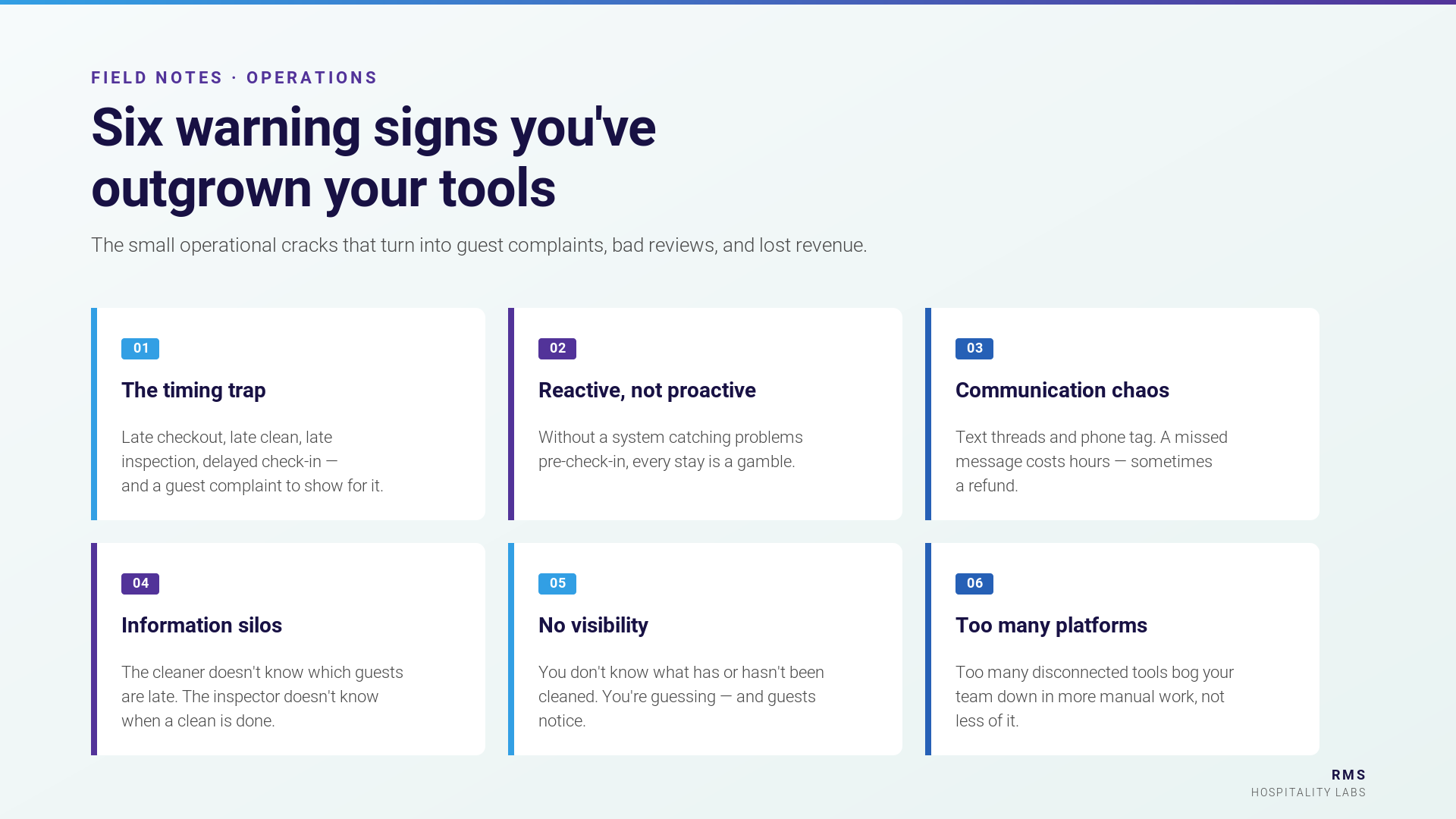
Maria described what she calls "the timing trap": a late checkout delays the clean, which delays the inspection, which delays the check-in — and suddenly every stay feels like a gamble. Layer on the communication chaos of WhatsApp, text, and Excel running in parallel, plus platforms that don't talk to each other, and you end up with information silos. The cleaner doesn't know the guest is leaving late. The inspector doesn't know the clean is finished. Managers lose real-time visibility and start guessing.
"Most operators recognise these challenges when they hear them," Maria said. "But they're so used to working with them, they don't realise it's a tooling issue." That observation landed with me. It's true well beyond short-term rentals. It's definitely true for me in marketing.
Nox's approach: Build an ecosystem, not a shopping list.
What stood out about Nox's tech stack is that Dominika never described the tools as standalone. RMS sits at the centre as the PMS. Breezeway handles operations and workflow automation. Around that, she layers reservations tools, marketing platforms, a financial system, and a CRM. Her evaluation criteria weren't about features in isolation; they were about integration and whether each tool closed a loop with the others.
The result is that her teams — operations, revenue and sales, reservations, procurement, finance, and admin — stop sending each other messages and start sending each other tasks. Onboarding a new property flows through the system. Owner approvals happen in the system. Inspection reports go to landlords through the system, with photos attached. And if a dispute surfaces two years later about the condition of an apartment at handover, Dominika doesn't go hunting through email threads — she pulls up the record.
"The system is as good as the data you feed it," she said, more than once. It's a good line to sit with, and again something i can fully attest to in other areas of business.
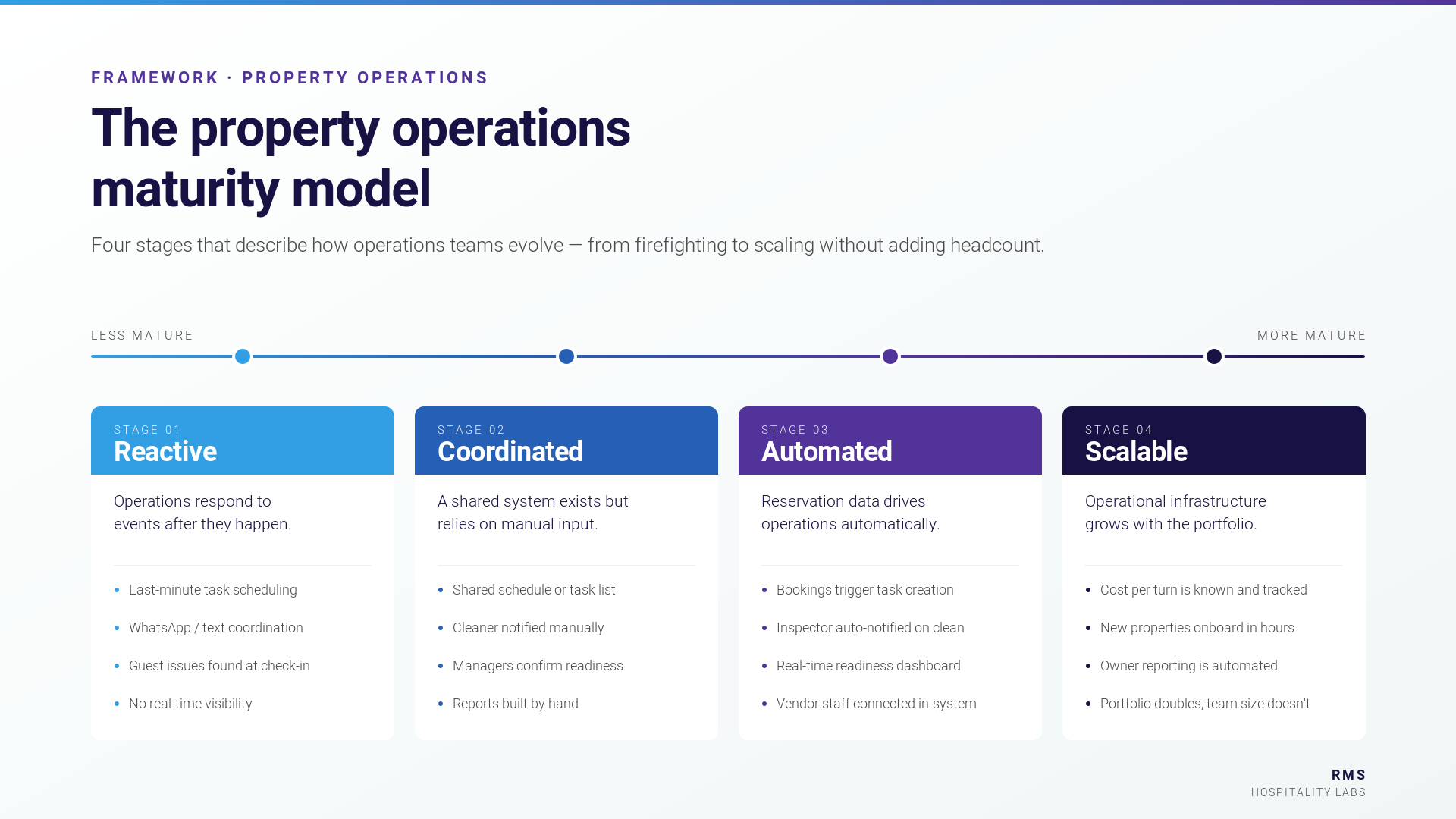
The four stages of property operations maturity
Maria provided a valuable framework for operators to rate the maturity of their property operations. It maps the journey in four stages: Reactive, Coordinated, Automated, Scalable. When we polled the audience, most placed themselves at Stage 1, the very reactive end of the scale. That tracks with what I hear anecdotally, and I suspect it's true across many industries, not just short-term rentals.
How to get started?
Dominika's guidance for anyone still firefighting was the most practical stretch of the hour. Don't wait for things to break, introduce the tools early, before workarounds calcify into habits and before the team starts resisting change on principle. Map your operation end-to-end: bookings, housekeeping, inspections, maintenance, procurement, owner approvals — and you'll quickly see where time leaks and where errors happen. Don't try to change everything at once. Build the foundations first, then scale with confidence.
Maria's version was the same idea, scoped down: pick one point of friction this week and remove it. Replace "messaging the cleaners every time" with one shared task list everyone refers to.
On team resistance — yes, it happened, but it didn't last long
I asked Dominika how her team reacted when she introduced a new operations platform. She was candid: there was initial resistance, which she described as natural. The team was used to informal WhatsApp threads, and moving to a structured system was an adjustment. What shifted the mood was the experience of working in it — clearer task assignment, clearer expectations, and far less double-checking between departments. "It reduced stress during our high-pressure moments," she said. For any operator familiar with a turnover window, that's a meaningful change.
She added a point worth underlining: consistency matters. The system only delivers if the team feeds it properly — closing tasks, logging data, attaching evidence. Without that discipline, the reporting layer loses its value.
Where this leaves us.
The takeaway I'll carry from this session is Dominika's insistence that scale should feel more predictable, not less. Adding a property should get easier with each one, because the system already knows what good looks like. If growth is adding friction, the tooling is the problem — not the team.
If you missed the session, it's worth catching on replay. Dominika's case study with Breezeway is a useful companion read, and the integration between RMS and Breezeway is straightforward to set up — typically two to four weeks, according to Maria, depending on portfolio size.
Next month's Learning Labs session is all about payments. I hope you'll join us!