



In sectors where lost time translates directly to lost production, the fragility of manual workforce logistics has become impossible to ignore. Two Australian-based platforms are partnering to change how the world's largest resource operators keep their people moving.
Every shift in mining and energy begins with a journey. A charter flight out of Perth or Brisbane. A bus winding through remote country at 2am. A check-in at a camp hundreds of kilometres from the nearest town. Multiply that by thousands of workers a week, across multiple sites, rotating in and out on complex schedules, and the scale of what resource operators coordinate becomes clear.
For decades, the machinery behind that coordination has run on patched-together systems: flight bookings in one tool, buses in another, accommodation tracked on spreadsheets, contractors being post-billed for travel, and the whole operation propped up by a coordinator who "knows the system" - until the day they don't.
For operations where lost time translates into numbers with many zeros, this fragility is an operational risk, not just a back-office problem.
It's very hard to articulate costs against production, but it's usually calculated in the millions.
- Cameron Brown, COO of Uplift Logistics
"It's very hard to articulate costs against production, but it's usually calculated in the millions," says Cameron Brown, COO of Uplift Logistics. The symptoms are the same almost everywhere he looks: fragmented visibility across half a dozen systems, duplicated data entry, and a reliance on processes that exist only because that's how it has always been done.
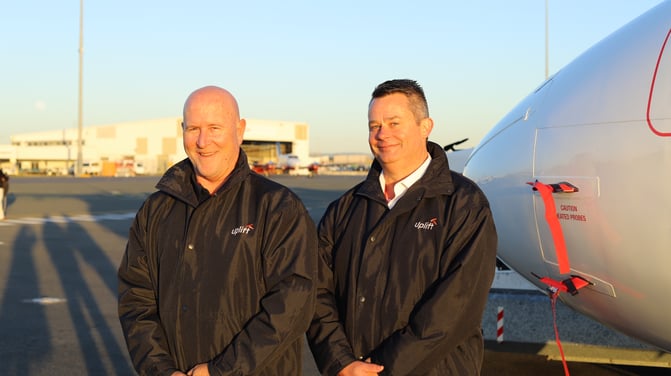
Jason Barnes, CEO & Cameron Brown, COO - Uplift Logistics
The problem isn't technology. It's legacy thinking.
That phrase - that's how we've always done it - sits at the heart of the problem Uplift set out to solve.
The Australian-built platform acts as the single connective layer between a resource company and its travel ecosystem: charter flights, buses, pool vehicles, accommodation, and the suppliers behind each of them. Where spreadsheets and email chains once stitched the moving parts together,
Uplift replaces the manual connective tissue with automated APIs, configurable workflows and a real-time single source of truth.
Critically, Uplift isn't a travel agency dressed up in software. The platform doesn't contract the charter operators or the accommodation providers - the client retains those commercial relationships. What Uplift delivers is the operating system that makes those relationships work at scale: configured to each client's travel policy, approval chains, user permissions and operational rules. Contractors see only their own people. Approvers receive auto-routed requests. Room-night caps, charter utilisation rules, booking restrictions - all built into the configuration.
Cameron describes the company's proposition as "flexibility vs legacy." Not legacy in the sense of age, he clarifies, but legacy in the sense of the trap: clients who believe no alternative exists to the way they've always worked.
Where RMS completes the circle
RMS is one of the world's most capable platforms for managing camp accommodation operations - room configurations, housekeeping, maintenance, guest management and reporting. Uplift, meanwhile, owns the front end of the workforce journey: the moment a roster is finalised through to the flight, the bus, the check-in, and the stay.
By integrating directly with RMS via API, Uplift closes the loop. A booking made in Uplift updates RMS in real time. A change at camp- an extra night, a re-routed flight-flows back through the system automatically, with the airline, the bus operator and the property receiving confirmation simultaneously.
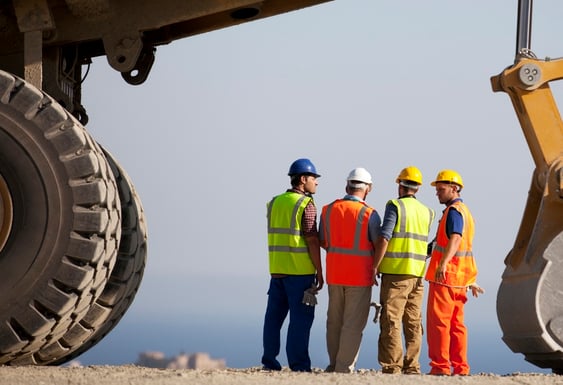
"Our integration with RMS just completes the circle," says Jason Barnes, Uplift's CEO.
Ultimately, for the employee / contractor, the result is simple. A technician sitting at camp, told their rotation has been extended by two nights, can open their phone, make the change, and have accommodation, flights and buses updated instantly. No coordinators, no emails, no waiting.
In one engagement, Uplift identified more than $700,000 a year in irreconcilable room nights.
The cost of the status quo
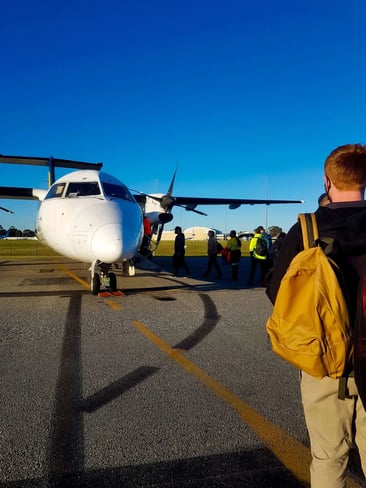
The price of getting this wrong is measurable.
In one engagement, Uplift identified more than $700,000 a year in irreconcilable room nights - accommodation being invoiced but not reliably consumed, a gap invisible to the client's existing manual process. Automating the reconciliation recovered the money and freed the team that had been spending its days chasing discrepancies.
For operators like BHP and Shell - both long-standing Uplift clients - the value compounds in less obvious ways. Travel teams have shrunk or been redeployed. Back-office reconciliation work has largely dried up. Additionally the duty-of-care picture has sharpened considerably.
When a chartered bus picks up a worker from a remote stop at 2am, the driver checks them in via the Uplift mobilised app. This small action means the site knows instantly who is on board. "To confirm, for example, that ‘Sally from Production’ is on that bus is invaluable," Cameron says. In sectors under rising scrutiny on workforce welfare and OH&S compliance, that visibility matters.
Two platforms. One workforce journey
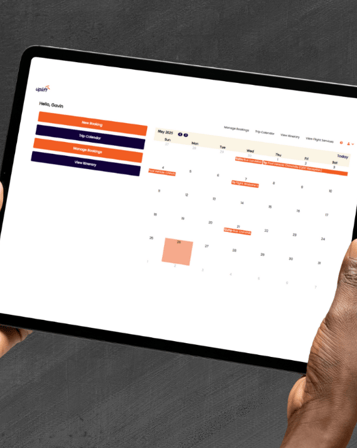 What makes the Uplift x RMS partnership work is that neither platform is trying to be the other. Uplift is not attempting to manage a camp. RMS is not trying to book flights.
Each brings deep subject-matter expertise to its own part of the workforce journey, and the integration between them lets clients benefit from both without compromise.
Jason is clear that the roadmap doesn't stop at Australia. The Uplift team is constantly developing bespoke customer enhancements around the world, and those enhancements ultimately flow back to every customer on the platform, including those at home in Australia. Advanced roster booking, AI-assisted personalisation and deeper air-charter capabilities are all in the pipeline.
For operators still running workforce logistics on legacy processes and institutional memory, the question isn't whether the model is broken - it's whether they can afford to keep pretending it isn't.