



What to look for when choosing channel management software
You've just manually updated your rates on Booking.com when a guest books your last waterfront suite through Expedia—the same suite you forgot to close on Airbnb. Now you're scrambling to move another guest, apologizing profusely, and watching your property's ratings take a hit because you're juggling five different online travel agency (OTA) platforms and can't keep up.
This is the reality for thousands of hoteliers managing distribution every day. You're not just running a hotel—you're running a logistics operation across a dozen platforms, each with its own login, its own quirks, and its own way of creating chaos when you're already stretched thin.
A channel manager system changes that equation. Instead of logging into multiple OTA extranets to update rates and availability, you manage everything from one dashboard. When a booking comes through any channel, your inventory updates everywhere—automatically, in real time. No double bookings. No forgotten updates. No panic.
Convinced you need one? Well, now you have to decide what is the best channel management software for your property. The one that matches your specific needs, your distribution strategy, and solves your biggest operational challenges.
What is a channel manager in a hotel?
What is channel manager software? At its core, it's a technology platform that connects your property management system (PMS) to OTAs, your booking engine, global distribution systems (GDS), and other sales channels—syncing your room inventory, rates, and availability across all of them automatically.
Think of it this way: without a channel manager, you're conducting an orchestra where every musician is in a different building. You run from room to room, hoping they heard you correctly, praying they're all in sync. With a channel manager, everyone's in the same concert hall, reading from the same sheet music.
When a guest books through Booking.com, the channel manager instantly updates your availability on Expedia, Airbnb, your direct booking engine, and every other connected platform. When you adjust rates for weekend demand, the change is pushed to all channels in seconds. When you need to close sales, one update does the job everywhere.
With RMS, this happens from a single dashboard—no logging into multiple systems, no juggling separate platforms. Everything's connected because the channel manager, PMS, and booking engine are built to work together.
It's the difference between managing distribution and drowning in it.
Benefits of channel management software
The advantages of using channel management software extend far beyond avoiding double bookings. When it's built into your PMS like RMS, these benefits multiply because everything works together seamlessly.
- Increased efficiency and time savings: Reclaim hours spent logging into multiple OTA extranets. Those hours go toward improving guest experiences, training staff, or developing marketing strategies.
- Real-time updates across all channels: Updates happen in seconds. The moment a booking is made anywhere, availability adjusts everywhere—no lag, no overbookings.
- Centralized reservation management: One source of truth. See complete, accurate data in real time—exactly how many rooms you have to sell, where revenue is coming from, and how each channel is performing.
- Dynamic rate management: Respond to market conditions in minutes. Competitor drops rates? Adjust across all channels instantly. Local event driving demand? Push rate increases everywhere simultaneously.
- Improved distribution strategies: Finally, see what's working. Which OTAs drive bookings? Which channels deliver guests willing to pay premium rates? The data informs smarter decisions.
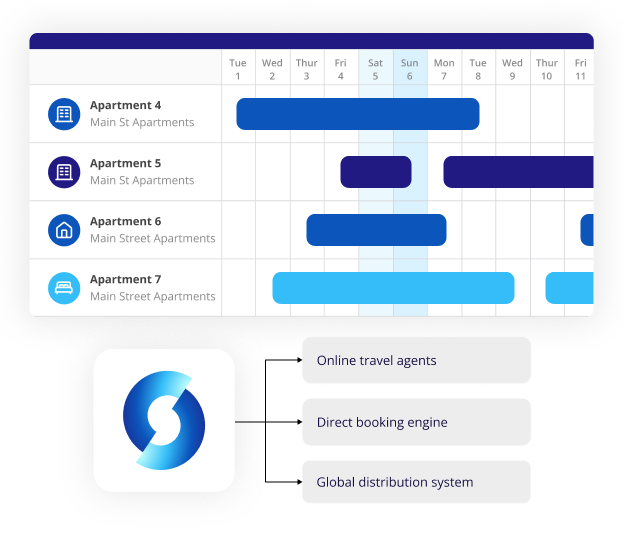
The RMS built-in channel manager delivers these benefits without additional cost—connecting to 100+ OTAs including Booking.com, Airbnb, and Expedia as part of your PMS, not as an expensive add-on.
What is the difference between a booking engine and channel manager?
This question trips up many hoteliers because the two systems sound similar but serve completely different purposes. A channel manager handles outbound distribution—connecting your inventory to OTAs, GDS, and other third-party platforms where guests search for accommodations. It automatically updates availability across all channels when bookings come in, preventing overbookings and keeping your rates synchronized. A booking engine powers direct bookings on your website through the "Book Now" button, letting guests check availability, see rates, and complete reservations without going through Booking.com or Expedia.
The difference between booking engine and channel manager isn't about choosing one or the other—it's understanding how they work together. Channel management expands your reach through OTAs, while your booking engine captures guests who come directly to your website. The challenge is keeping both systems (plus all your sales channels) in sync without manual updates eating up your day.
RMS is the best channel manager because it integrates both systems seamlessly—connecting you to major OTAs while providing a commission-free booking engine for your website. Every reservation, whether it comes from Booking.com or your own site, flows into your PMS instantly and updates availability everywhere. One platform, complete distribution control, zero double bookings.
Key features and integrations to look for
When evaluating what is the best channel management software for your property, certain features separate truly useful platforms from ones that create more problems than they solve.
|
Feature |
Why It Matters |
What to Look For |
|
OTA Connectivity |
Determines your distribution reach |
Connections to Booking.com, Expedia, Airbnb minimum; 100+ OTAs |
|
PMS Integration |
Makes or breaks operational efficiency |
Two-way sync: bookings flow in, rates push out automatically |
|
Automation |
Defines time savings |
Auto rate rules, scheduled stop-sells, minimum stay requirements |
|
User Interface |
Impacts adoption and errors |
Clean dashboards, intuitive navigation, minimal clicks |
|
Scalability |
Supports business growth |
Multi-property management, enterprise-level control |
|
Security & Compliance |
Protects your business |
Payment card industry (PCI) compliance, data encryption, General Data Protection Regulation (GDPR) adherence |
|
Analytics |
Enables optimization |
Channel performance, booking windows, revenue by source |
|
Mobile Access |
Allows on-the-go management |
Update rates and check availability from anywhere |
RMS delivers on all these fronts: 100+ OTA connections, seamless PMS integration, automation that reduces manual work by hours per day, enterprise-grade security, comprehensive reporting, and mobile access.
How to choose the right channel manager
Selecting the best channel manager for hotels starts with understanding your specific needs—not buying the most feature-rich platform on the market.
What to evaluate
- Your business requirements: How many channels do you use? Is GDS required for corporate business? Managing one property or multiple?
- Budget and pricing models: Pricing models vary, some are per room or per channel, while others are commission-based. Watch for hidden costs: setup fees, training, charges for adding channels.
- Support quality: When connections fail during peak season, response time matters. Look for 24/7 support with fast resolution times.
- Industry reputation: Check verified user reviews from properties similar to yours in size and type.
- Trial before buying: Request demos, test actual functionality, verify PMS integrations work as promised.
RMS includes comprehensive channel management as part of your property management system at no additional cost, connecting to OTAs without per-channel fees.
Industry-specific applications
You also need to consider how channel management software serves different property types with distinct needs:
- Hotels and resorts: Need broad OTA connectivity, GDS access for corporate bookings, sophisticated rate management across room types, and multi-property centralized control.
- Vacation rentals: Prioritize Airbnb alongside Booking.com. Require longer minimum stays, weekly/monthly pricing, and owner usage blocking.
- High-volume properties: Campgrounds, hostels, student accommodation managing hundreds of units need systems that handle scale efficiently.
RMS serves all these property types with flexibility to configure for your specific needs.
Market trends and developments
The channel management landscape continuously evolves.
- AI and automation: Platforms now use machine learning to analyze booking patterns and competitor pricing, automatically adjusting rates to optimize revenue.
- Self-service solutions: Modern interfaces prioritize ease of use. Setup that once took weeks now happens in hours.
- Data privacy and compliance: Stricter regulations like GDPR require robust security while maintaining seamless data flow.
- Integration ecosystems: Channel managers must work with revenue management systems, reputation platforms, and guest communication tools.
How RMS turns channel management into a competitive advantage
RMS recognizes that your PMS, channel manager, and booking engine shouldn't be three separate systems you're forced to integrate. Everything works from one unified platform—one dashboard, one login, complete visibility. No logging into your PMS to check occupancy, switching to your channel manager to update rates, then checking your booking engine separately. And because channel management is built in, there's no additional cost. RMS connects to 100+ OTAs including Booking.com, Airbnb, and Expedia with no per-channel fees.
Real-time synchronization happens in seconds, and rate management gives you the flexibility to optimize for different channels. Offer discounts through your direct booking engine to reduce OTA commissions. Set minimum stay requirements for Airbnb but not Booking.com. Comprehensive reporting connects channel performance to actual business outcomes—which OTAs drive guests willing to pay premium rates, which channels fill shoulder season occupancy. The data informs smarter distribution decisions.
Lafayette Hotels boosted direct bookings by 70% and saved over $100k annually after unifying operations with RMS—demonstrating how integrated channel management drives both revenue growth and cost reduction.
Your Channel Management Software Checklist
- Connects to your most important OTAs without per-channel fees
- Integrates seamlessly with your existing PMS (or better yet, they're the same system)
- Updates availability in real time across all channels (seconds, not minutes)
- Provides intuitive interface requiring minimal training
- Includes mobile access for on-the-go rate updates
- Offers comprehensive reporting on channel performance
- Scales with your business as you add rooms or properties
- Maintains PCI and GDPR compliance for data security
- Provides responsive support when issues arise
- Fits your budget without hidden fees or surprise charges
Finding the right distribution partner
What is the best channel management software for your property? It's the one that solves your specific distribution challenges without creating new operational headaches.
It's not necessarily the platform with the most OTA connections if you only use five channels. The cheapest option is not the best if it lacks critical features you need. Nor is the most expensive if you're managing a boutique hotel that needs simplicity more than sophistication.
For many properties, integrated platforms like RMS make the most sense—combining property management, channel management, and direct booking in one system rather than forcing you to connect three separate platforms from different vendors. You avoid integration headaches, eliminate redundant costs, and get everything designed to work together.
Whatever route you choose, make the decision based on your actual needs. Request real demos. Talk to managers of properties like yours about what they use and why. Test platforms during trial periods.
The right channel manager transforms distribution from a source of stress into a competitive advantage. Choose wisely.
FAQs
Looking for the essentials? Here are straightforward answers to the most common questions about channel manager software.
What is channel manager software?
Channel manager software connects your property management system to multiple OTAs and booking platforms—automatically synchronizing room availability, rates, and restrictions across all of them from one dashboard.
What is the difference between a booking engine and a channel manager?
A booking engine powers direct reservations on your hotel's website, while a channel manager distributes your inventory to third-party OTAs like Booking.com and Expedia. Both should integrate with your PMS for unified inventory management.
How much do channel managers cost?
Pricing varies based on property size, connected channels, and features. Some vendors charge per room or per channel, others take commissions. Watch for hidden costs like setup fees or charges for adding OTA connections. RMS includes comprehensive channel management as part of your PMS at no additional cost.
What is the best channel manager for hotels?
The best channel manager depends on your property's needs—size, distribution strategy, budget, and tech stack. Look for platforms that connect to your most important OTAs, integrate with your PMS, provide real-time updates, and offer responsive support. Integrated solutions like RMS often deliver better results than standalone channel managers.
What is a channel manager in a hotel context?
In hotel operations, a channel manager manages your online distribution—connecting your property to OTAs, GDS, and other booking platforms. It ensures rate parity, prevents overbookings, and gives you centralized control over where your rooms are sold online.