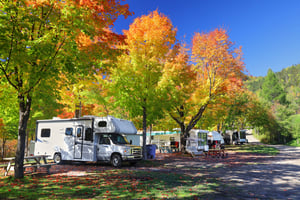
You've found the land. You've done the drive. You can already picture the sites, the trees, the fire rings, guests pulling in on a Friday afternoon.
Then you need to put it all down on paper. Not just for a lender, but to prove to yourself the business works.
A solid RV park business plan is the document that brings your idea into focus. It forces you to work through the numbers, identify the gaps, and build a roadmap you can actually follow. Yes, it's essential for securing funding, but it's equally valuable as a planning tool - whether you're self-funding or seeking investors. Using an RV park business plan template can help structure your thinking, but the analysis needs to be your own.
Here's how to approach every section.
What goes in an RV park business plan
Before diving into each section, here's the structure most investors and lenders expect to see:
- Executive summary: Your concept, location rationale, projected revenue, required capital, and long-term vision
- Market analysis: Industry research, local demand, target audience, and competitor analysis
- Location and zoning: Site selection considerations, zoning status, and accessibility
- Legal requirements: Permits, licenses, and regulatory compliance
- Park design and infrastructure: Site mix, layout, amenities, and capital requirements (land preparation, utilities, hookups, buildings, equipment).
- Business model and revenue: Income streams, pricing strategy, and seasonal management
- Operations plan: Staffing, systems, and daily procedures
- Marketing strategy: How you'll attract and retain guests
- Financial projections: Three-year revenue forecasts, startup costs, and operating expenses
- Sustainability: Environmental impact and conservation measures
Each section needs to demonstrate that you've thought through not just the concept, but the execution. Here's what to include in each.
Executive summary and company overview
The executive summary comes first in your document but should be written last. It's a one to two page overview covering your park's concept, location rationale, target market, competitive advantage, revenue projections, capital requirements, and expected return on investment. This section needs to stand alone because many investors read only this before deciding whether to continue.
The company overview documents your legal structure (Limited Liability Corporation (LLC), corporation, partnership), ownership percentages, and the background and experience of the founding team. Highlight any hospitality, real estate development, or property management experience that demonstrates your ability to execute the plan.
Market research and industry analysis
Your business plan needs to demonstrate that you understand the RV park industry, the trends shaping it, and the specific market you're entering.
Start with the big picture. Research overall camping participation rates in your region, current industry trends (seasonal patterns, the shift toward longer stays, the growing share of first-time campers), and what's driving demand in your specific area. National parks, beach access, highway corridors, outdoor recreation areas, and regional events all create distinct types of demand that your park either captures or misses.
Then get specific. Define your target audience clearly: weekend leisure travelers, seasonal snowbirds, families with children, and digital nomads have different booking behaviors and expectations. Customer segmentation at this stage shapes almost every other section of your plan.
Competitor analysis matters here too. Identify nearby parks and list their site mix, pricing models, and amenity offering. Take note of any gaps revealed by guest reviews. Understanding what competitors aren't doing well is as valuable as understanding what they are.
Location selection and zoning
This section is where you explore and document considerations for choosing a suitable location for an RV park, including land use requirements, zoning regulations, accessibility, and proximity to attractions.
It's important to do a thorough investigation because land that looks right on a map may not be designated for commercial recreational use, or may require rezoning that adds months and significant cost.
Confirm the zoning classification and whether the land can legally operate as an RV park. If rezoning is planned, make note of the timeline.
Investigate and document utility access. There is significant additional cost in managing onsite sewage systems, building water tanks or wells, and implementing independent power systems if the site is not serviced. Wi-Fi access and reliable cell signal are no longer optional for guests. Sewage and waste management systems, and a water distribution system need to be sized for peak occupancy, not average. These decisions are expensive to revisit once infrastructure is in the ground.
Beyond zoning and land use regulations, work through the practical site considerations: terrain and drainage, highway access for larger rigs, proximity to natural attractions and nearby towns.
Legal requirements and permits
There are licenses, permits, and regulatory considerations involved in starting and operating an RV park. These need to be investigated and documented. Depending on the complexity of operations and the location, you may require: zoning approvals for commercial recreational use, construction permits for all permanent structures, water usage permits and wastewater treatment permits, environmental permits, health department approvals, fire safety requirements, and emergency access requirements.
Environmental impact assessments may be required depending on the scale of development and the sensitivity of the site. Infrastructure development permits often cover roads, drainage, and utilities separately from building permits.
This is an overview; requirements vary significantly by jurisdiction. Permit timelines vary widely by state and county. Build this into your project plan. Include the cost of engaging a licensed attorney and, where relevant, zoning consultants in startup costs.
Park design and infrastructure
Infrastructure is your largest capital outlay and your tightest future constraint. Planning it well means optimizing space and access as well as deciding on the optimum mix of sites: full hookup with water, sewer, and electrical connections; electric-only, and primitive. Map out the road and pathways layout, parking pads, toilet blocks and shower facilities, setbacks for privacy, laundry facilities, common areas, a camp store if the concept warrants it, Wi-Fi infrastructure, and recreational facilities.

Business model and revenue streams
One of the most important questions in any RV park business plan is how the park will generate income and how it will stay profitable through slower periods.
The most common business models are built around a mix of nightly stays and long-term rentals. Nightly stays typically generate higher average daily rate (ADR) while long-term rentals offer more predictable, recurring income that helps offset seasonality.
Beyond standard RV sites, consider your accommodation mix: glamping options (cabins, bell tents, or luxury tents) and onsite RVs or park models offer alternatives at premium nightly rates.
When modeling income in your business plan, consider different pricing approaches for utilities: flat fees included in the site rate, metered electricity and water charged based on actual usage, or a hybrid model. Document which approach you'll use and how it affects your revenue projections. Your pricing strategy should account for seasonal variations and different guest segments.
Beyond site rentals, document revenue from equipment rentals such as golf carts or bikes, add-on fees for day use, and food and beverage if the concept supports it.
Return on investment for an RV park is directly tied to how well the revenue model handles the low season. A plan that only works at peak occupancy rates is a plan that doesn't survive year two.
Operations and management
The operations section of your business plan covers the daily operational procedures and management systems that will keep the park running. Investors want to see that you've thought through the day-to-day, not just the build.
Cover your staffing model: front desk and reservation staff, maintenance personnel, groundskeepers, and whether management is live-on-site or off-site. Define check-in and checkout procedures, routine inspections, infrastructure maintenance schedules, and emergency response and first aid protocols.
In your business plan, demonstrate how technology will support operations from day one. Include the cost of a property management system (PMS) in your startup budget and show how it offsets labor costs through automation. Document which systems you'll use for:
- Reservation management (online and front desk bookings)
- Guest communication (automated confirmations, pre-arrival instructions, post-stay follow-up)
- Payment processing (deposits, pre-authorizations, final settlement)
- Maintenance task management (assigning work orders, tracking completion)
- Reporting and analytics (occupancy, revenue, guest trends)
Factor in response times for requests, cleanliness benchmarks, quiet-hours rules, communication style across email, SMS, and on-site signage as well as guest-facing technology such as self check-in portals and mobile checkout, which reduce front desk workload while improving guest experience.
Marketing and customer acquisition
Your business plan needs to explain how you'll attract guests before you open and maintain occupancy year-round. Document your marketing timeline - when you'll launch your website, claim your Google Business Profile, and start taking reservations. Most successful parks begin building their online presence and accepting bookings 90 days before opening.
- Write a short explanation about how the core channels will be utilized
- A direct booking website with online booking capabilities
- Listings on campground platforms like Hipcamp, Campspot, and RV LIFE
- Google Business Profile claimed and optimized from day one
- Active social media presence on Instagram and Facebook with regular posts featuring site photos, nature shots, behind-the-scenes preparation, promotional offers, and local area tips
Plan how you'll collect and use reviews consistently from the start.
Outline promotional strategies such as pre-launch awareness, behind-the-scenes build videos to create a buzz and listings on RV/campground directories and OTAs, as well as partnerships with local attractions that will extend your reach to guests who wouldn't otherwise discover you.
In your business plan, explain how you'll make booking easy for guests from day one. Interactive site maps that show the park layout with real-time availability let guests choose their exact site at booking, which improves conversion rates and reduces front desk questions.
[CALLOUT BOX: RMS' interactive site maps provide guests with a geographically accurate view of your park, with real-time availability and site selection at booking.]
Include examples of dynamic pricing, managed through your PMS, and how it will help maintain occupancy through shoulder seasons.
Funding and financial planning
Your financial plan needs to demonstrate that the park can cover its startup costs, maintenance costs, service any debt, and generate a return. The common funding sources are bank loans, Small Business Administration (SBA) loans for qualifying US operators, private investors, and in some cases crowdfunding for smaller or community-oriented projects.
On the cost side, the major startup costs are land acquisition, site development expenses and civil works, infrastructure and utility setup, amenity buildings, equipment, software, permits, professional fees, and a working capital reserve. Don't underestimate the working capital line - it's what keeps the lights on in a slow first season.
For financial projections, model a minimum three years with conservative occupancy assumptions. Build in operational expenses accurately: staffing, utilities, insurance, maintenance, marketing, and software. A projection that only works at optimistic occupancy is a liability in a lender conversation.
The key metrics: occupancy rate, ADR, Revenue per Available Site (RevPAS), which is ADR multiplied by occupancy, and Net Operating Income (NOI), being revenue minus operational expenses before debt service.
RV park business plan templates are widely available online and worth reviewing for structure, but the numbers and analysis need to be your own.
Sustainability and environmental practices
A sustainability section is increasingly expected by lenders and is a genuine factor in guest choice. Cover the basics: energy efficiency measures across the park, your waste management approach, water conservation, and how the development minimizes impact on the surrounding environment. Conservation efforts that are built into the design (native landscaping, protected natural areas within the park) are worth noting specifically.
Where sustainability and profitability directly overlap is utility monitoring. In your business plan, document how you'll track utility consumption. RMS has features such as Utility Meters to track usage by site and automate billing, giving you accurate data for both cost control and guest reporting.

A plan you'll actually use
Once the park is open, the projections you wrote become the benchmarks you measure against. The procedures you outlined become onboarding materials for new staff. The market analysis tells you whether reality is matching your assumptions.
The parks that perform well aren't always the ones with the most detailed plans. They're the ones that keep referring back to them.
Once your plan is complete, the right technology makes it easier to execute. See how RMS supports RV park operators from opening day onwards.
FAQs about RV park business plans
- What should be included in an RV park business plan?
An RV park business plan should cover your business concept, market research, location and zoning requirements, startup costs, revenue streams, operational procedures, marketing strategy, and financial projections.It should also outline your target guests, competitive positioning, staffing requirements, and the technology you'll use to manage reservations, payments, and day-to-day operations.A comprehensive business plan helps you assess financial viability, secure funding, and establish a clear roadmap for launching and operating your RV park. - How much does it cost to start an RV park?
The cost of starting an RV park varies significantly depending on location, land prices, the number of sites, infrastructure requirements, and planned amenities.Major expenses typically include land acquisition, site development, utility hookups, roads, buildings, permits, equipment, and property management software.Your RV park business plan should include a detailed startup budget alongside ongoing operating expenses and a working capital reserve to cover costs during slower periods. - How do you calculate potential revenue for an RV park?
Start by estimating the number of available sites, your average daily rate (ADR), and expected occupancy throughout the year.For example, an RV park with 100 sites, an average nightly rate of $60, and 60% occupancy would generate approximately $1.31 million in annual site rental revenue before operating expenses.Your financial projections should also account for seasonal demand, long-term rentals, additional accommodation types, and supplementary income from amenities or services.Using conservative occupancy assumptions will help you develop a more realistic financial forecast. - How far ahead should you plan your RV park's finances?
An RV park business plan should generally include financial projections covering at least three years.These should outline expected revenue, operating expenses, cash flow, and potential profitability, taking seasonal fluctuations into account.It's also worth preparing different financial scenarios to understand how changes in occupancy, pricing, or operating costs could affect the business.Regularly reviewing actual performance against these projections will help you make informed decisions as your RV park grows. - Why is property management software important in an RV park business plan?
Property management software (PMS) helps RV park operators manage reservations, guest communications, payments, reporting, and daily operations from a central system.Including a PMS in your business plan allows you to account for technology costs from the outset and demonstrate how automation can reduce administrative workload.Features such as online booking, interactive site maps, and dynamic pricing can also support the guest experience and help operators manage occupancy and revenue more effectively.