


Yesterday, I found myself at a rather lovely London lunch, invited by Jessica Gillingham and the team at Abode Worldwide. The concept was simple and quite reassuring for someone who's been working remotely from my home office for the best part of 5 years: Get hospitality tech marketers (that's me, selling software to hotels) in a room with hospitality operator marketers (the people actually running marketing for hotels, parks, and the like), add a wine flight, and see what happens.
The short answer: a lot of nodding, a surprising amount of "wait, us too," and one very firm personal conclusion: I am not quite ready to cross over to the operator side. Does that mean I might never realize my dream of working for the Belmond brand? Well, yes, potentially. More on that in a moment.
What makes their world hard (And makes me grateful for mine)
The CRM situation is... a lot
One operator at the table mentioned, almost in passing, that they run four separate CRMs. One per line of business: membership, extended stay, hotel, wellness. Four systems. One property. I'll give you a moment to sit on that. When I joined RMS, we were running on two different HubSpot instances and even that was too much.
Now imagine trying to reconcile guest data across all four, then picture what happens when you want to expand. It becomes less of a marketing challenge and more of an archaeological dig.
The broader issue is that hospitality operators are still largely running on purpose-built, industry-specific software (which is good news for all of us tech vendors out there) and, honestly, there are real reasons for it. The data model for a hotel booking is genuinely complicated. You can have the travel agent who made the booking, the name on the booking (which might be a guest's EA, not the guest), and the actual guest. Throw in children and loyalty programme quirks and VIP statuses, and suddenly you've got a philosophical debate about who your customer even is, let alone who you should be marketing to.
Standard CRMs like HubSpot or Salesforce simply aren't built for this level of nuance — yet. I'll just leave a gentle hint here for Dharmesh Shah, Hubspot's famous founder and CTO: a hotel-specific module doesn't seem like a massive stretch, and there's a very willing vertical waiting for it.
GDPR hits differently when your customer is a person, not a company
In B2B, GDPR is something we all comply with, but it's not exactly keeping us up at night. For hotels, it's a different story. They are marketing to individual guests, which puts them squarely in B2C territory, and under considerably more scrutiny. Add the complexity of "who exactly consented to what" across four CRMs and multiple guest profiles, and you start to understand why the compliance conversation around the table felt a touch more existential than mine usually does.
No marketing ops, no problem? (Except it is a problem)
Perhaps the thing that made me most grateful for my own setup: hospitality operator marketers are largely doing this without a dedicated marketing operations function. Our own research at RMS backs this up: the number of systems an operator juggles (PMS, CRM, RMS, door locks, guest experience platforms, chatbots...) is genuinely staggering, and the teams wrangling it all are lean. Patching data together, building a coherent view of the guest journey, reporting back to the business, all without the marketing ops scaffolding that those of us in SaaS have come to rely on. Genuinely impressive. I would not cope.
But, we still have more in common than you'd think
Here's where it got interesting. Strip away the tech stacks and the org structures, and we're all basically dealing with the same headaches.
Everyone's fighting for direct revenue
For hotel marketers, the enemy is the OTA. The mandate has been the same for years: Grow direct bookings, reduce dependence on commission-heavy third-party channels. In SaaS marketing, the equivalent battle is with your own sales team: Who sourced that lead? Was it marketing or was it sales? 'What do you mean, it was your one phone call that moved to an opportunity? This contact has been reading all our newsletters religiously for a year and attended all our webinars". True story: you can hear the underlying PTSD.
When you're dealing with a compensation-incentivised sales org, it gets spicy. Different opponent, same tug-of-war.
The LLMs are giving underground Berlin club vibes: Everyone wants to get in, but no one knows how to find the door.
This one generated the most animated conversation. Everyone around the table, regardless of which side of hospitality they were on, is grappling with the shift away from traditional marketing tactics, particularly SEO.
For fifteen-odd years, SEO had rules. Yes, they evolved, but the mechanics were legible: find your keywords, write good content, structure it nicely, earn links, rank. It wasn't always easy, but it was knowable. You had a path to get there, and you knew that if you put in the graft and followed the rules, the top Google organic search spot was surely yours.
LLMs are not that easy to work through. Not yet, anyway. We're all piling content in, watching an "AI visibility score" tick up or down in our tools of choice (HubSpot native, Semrush's AEO tool...), and largely having no clear idea what's actually moving the needle. Your Gemini visibility is 42. Great. Why? What got you there? Which piece of content? Which signal? Nobody quite knows, which makes it very hard to do more of what's working and less of what isn't, which is, of course, the only thing a marketer with a tight budget actually needs to do.
It's like a Berlin nightclub: everyone agrees you need to be in it, and nobody can find the door.
The reliable stuff is still reliable
Which is probably why, across the table, everyone's still leaning on the things that we know work. Google paid search remains a staple: yes, traffic is down, and bids are up (Unresonably up, Google 😠) but it still converts, and for hotels specifically, Google Hotel Ads is still driving meaningful direct bookings.
For SaaS marketers, Google Ads remains a top channel, and even some of our competitors have doubled down on their investment. (Unrelated note, this thread here is still one of my best Linkedin read of 2026). Face-to-face events interactions remain one of the few channels where you can be reasonably confident you're talking to a human with genuine intent. There's something reassuring about that.
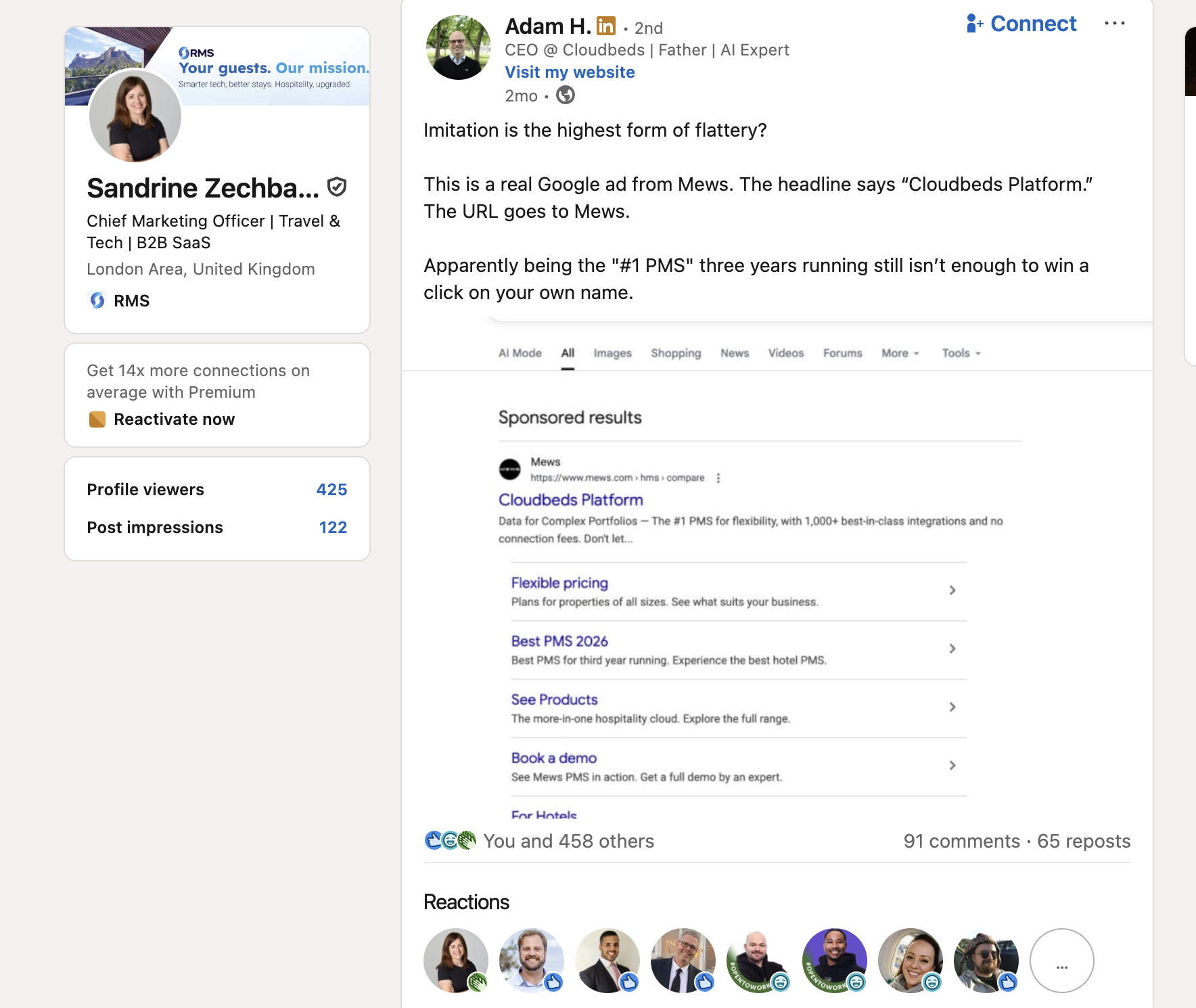 An excellent read, not as good as the RMS. vs Mews thread from 2025, but good nonetheless.
Attribution is still hard, but we've all quietly made peace with it
Attribution has been the great marketing debate for years. Whose activity closed the deal? Was it the event, the content, the ad, the email? The conversation around the table suggested something interesting: the noise around this has quietened. Not because we've solved it, but because there's a growing shared understanding, both in hotels and in SaaS, that the answer is almost always "a bit of all of it." The guest saw a magazine feature, then a tube ad, then searched, then read a blog post. The software buyer met you at a conference, read a case study, and had a call. It's never just one thing.
That doesn't mean measurement doesn't matter and that you shouldn't track your efforts. You still need to justify your budget and own your numbers, but the internal politics around attribution seem to have mellowed. Progress, of a sort.
So, would I switch?
No. Not a chance. But I already had considerable respect for the folks doing the work, and that has only increased, and I have a much better understanding of why the hospitality tech industry still has a long runway ahead of it. The complexity is real, the gaps are real, and the teams navigating it are doing so with impressive resourcefulness. Belmond will have to wait to get their hands on me, much to their disappointment, I'm sure.
Lovely lunch, excellent wine, great company, would attend again.