

.png?width=200&height=200&name=Isabel%20Stonehouse%20(Mauve).png)
Adding premium accommodation to a holiday park used to mean a major construction project, a long lead time and a bill well into six figures to match. Tiny homes are changing that.
Design-led stays are one of the fastest-growing segments in outdoor hospitality. Think architect-designed structures, interiors worthy of their own Instagram post and accommodation that feels like the destination itself. Guests are seeking out these experiences deliberately, booking further in advance and paying more for them. For park operators, the question isn’t whether to diversify their accommodation mix, it’s how to do it without taking on the cost and complexity of a permanent build.
Tiny homes are increasingly the answer. They’re modular, relocatable and built to a standard that justifies a premium nightly rate, without the commitment of a permanent build and a six figure investment. Big Tiny has built its entire model around that opportunity. And park operators globally are paying attention.
-1.jpg?width=536&height=357&name=250505_Glenlyon_GoldenHourHideaway-101%20(8)-1.jpg)
From Singapore to the Grampians: the Big Tiny Story
Big Tiny started with a simple belief: that the best kind of travel isn’t just about extra amenities, more entertainment or a jam-packed itinerary. It’s about doing less in a place that makes doing that feel more meaningful.
Australia, where the landscape does the work for you, was the obvious place for Big Tiny to bring that idea to life. Put the right accommodation at the edge of the Grampians, or next to a lake in central Victoria, and the guest experience almost writes itself. They started by placing tiny homes on partner properties through Tiny Away, their hospitality arm. They worked with owners who had beautiful land but no infrastructure to host guests. Then they started buying and operating parks directly.
Today, Big Tiny spans three connected businesses: Build Tiny handles design and manufacturing, Tiny Away runs the bookings and land hosting network across over 20 countries, and Tiny Away Escape covers their owned and operated parks across Australia. That integrated model is the part worth paying attention to.
If a design detail isn’t working on the ground, they know it within a season and can fix it. When a new guest demographic starts emerging through their booking data, the product can respond. Most suppliers advise from the outside. Big Tiny runs the same P&L.
Most companies in this space either build or operate. We do both, and that changes everything.
Jeff Yeo, Co-founder of Big Tiny
Built to adapt: a product that grows with you
 The starting point for most park operators is the Reyes – Big Tiny’s flagship model. It can be relocated easily and it’s designed so that guests know immediately that they’re not in a standard cabin.
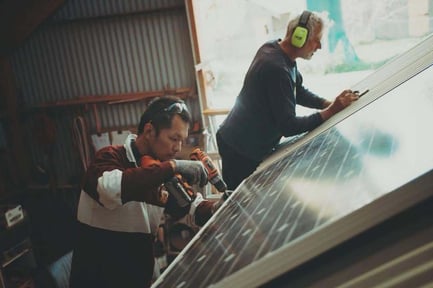
The more interesting story is the flexibility underneath it. Build Tiny’s construction system, which holds an innovation patent, is fully modular. Each panel is just over one metre wide and fully customisable in height. With thirteen models that have been tested, iterated and refined over several years, the range covers a solution for every guest profile – from couples seeking an escape through to larger families and group configurations. Assembly takes under three hours on site, and as a park’s needs evolve, the product can too.
The common thread is always design quality: every Big Tiny build is designed to be a destination in its own right. That commitment extends beyond aesthetics: the Global Sustainable Tourism Council certification the business holds across all operational sites gives operators the independently verified sustainability credentials to match.
One partnership, two ways in
Big Tiny offers two distinct pathways:
- Hotel in a Box: the turnkey option. Big Tiny supplies the structure, interior package and operational documentation, so you don’t have to build a procurement process from scratch.
- Land hosting programme: suits operators who want to test demand before committing capital. The landowner prepares the site. Big Tiny then places the unit on the land, manages it, handles marketing and reservations. The landowner earns a revenue share of 40% for standard sites and up to 45% if extra amenities are offered, plus a cleaning fee per completed booking.
We're not a catalogue supplier. The operators we work with best see this as a genuine partnership.
Jeff Yeo, Co-founder of Big Tiny
A new revenue tier, not a trade off
The first question operators might ask is whether tiny homes cannibalise their existing bookings. The short answer is no – and the guest profile explains why.
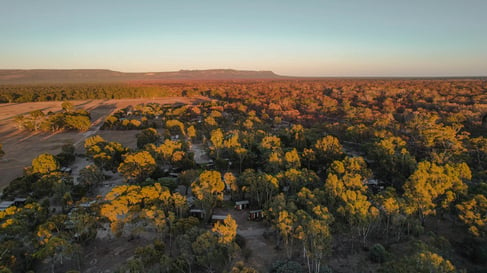
Three years ago, tiny home bookings skewed towards early adopters. Today, it’s a mainstream booking decision. Guests compare the experience to a boutique hotel or a luxury retreat, not the cabin next door. And they're not just booking a structure, they're booking the farm, the vineyard or the lake view around it. That means demand is new, not redistributed, and higher nightly rates are justified.
That then translates directly into a revenue story. Tiny home guests book further in advance, stay longer and come back. As Jeff puts it: "You're not just filling more nights. You're building a different kind of guest relationship." And at a fraction of the cost of a permanent structure, tiny homes are one of the few ways to add premium inventory without significant risk.
Parks that have adopted tiny homes successfully find they become the hero of their marketing, helping to boost occupancy across the rest of the property. For parks that already sit on scenic rural land, the tiny home is the accommodation category that matches the setting.
What to get right before the guest arrives
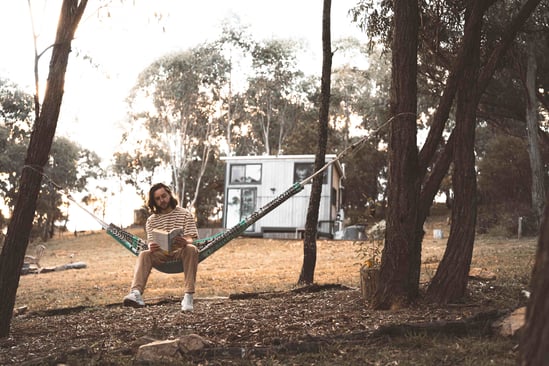
The product is only part of the equation. Based on operating their own parks and hosting 200,000+ guests through their network, Big Tiny flags three things consistently:
1. The real-life experience needs to match the imagery: guests have made a deliberate, premium booking based on what they’ve seen, so execution has to deliver.
2. Connectivity should be managed deliberately: guests want to feel off-grid, not actually be off-grid.
3. Placement matters as much as the product itself: how many units you place, where you position, the direction they face, and the privacy you create between them are what turn a good stay into a memorable one and keep guests coming back.
The bigger picture: what tiny homes mean for you
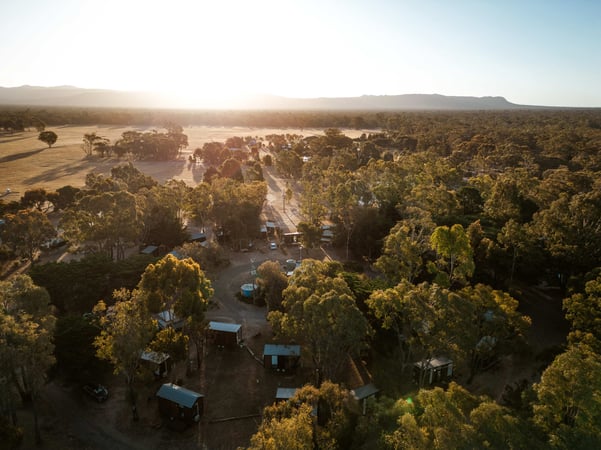
The tiny home opportunity goes beyond a single accommodation type. They offer a chance to unlock a new revenue tier, attract a higher-value guest and give landowners an accessible entry point to offering premium accommodation for the first time. Because the structures are relocatable, the planning conversation is simpler than operators might expect.
Big Tiny’s integrated model – building the product, running the bookings and operating parks themselves – means they can offer advice from a unique position. They know what the economics look like from the inside. They know what guests are responding to and asking for before most of the market does. And they know what it takes to deliver the right experience at scale.
For park operators considering how to level-up their accommodation offering, that kind of partnership is worth exploring.