



For independent accommodation operators, pricing is rarely just a tariff or rate.
It is tied to guest relationships, repeat business, reputation, reviews, occupancy pressure, and sometimes even personal pride in the property itself. Many operators know their rooms, cabins, sites or apartments better than anyone. They know the best features, the tired corners, the loyal guests, the local events, the quiet weeks and the busy seasons.
That closeness is one of the great strengths of independent hospitality. It creates care, consistency and a strong sense of ownership.
But when it comes to pricing, it can also become a challenge. Because the closer you are to your property, the harder it can be to price it objectively.
Pricing is often more emotional than operators realise
According to Matt Rose, RoomPriceGenie, “Many independent operators do not underprice because they lack commercial ambition. They underprice because they care: They care about whether a guest will think the price is fair. They care about loyal customers who have been staying with them for years. They care about reviews. They care about whether their property is "worth" a higher rate. They care about creating a positive guest experience.
Those instincts are understandable. They are also part of what makes independent hospitality so valuable.
“We see this often across independent operators, in that pricing decisions based too heavily on emotion can quietly limit revenue performance”. An operator may hesitate to move from $180 to $220 because they personally would not pay that amount. They may avoid increasing rates for a high-demand weekend because they do not want to upset regular guests. They may compare their property too harshly against newer competitors with flashier amenities. Or they may hold the same pricing structure year after year because it feels safe.
We see this often across independent operators, in that pricing decisions based too heavily on emotion can quietly limit revenue performance
- Matt Rose, RoomPriceGenie
The issue is not that operators do not understand their business. It is that they may be pricing from their own perspective, rather than the guest's.
Guests see value differently
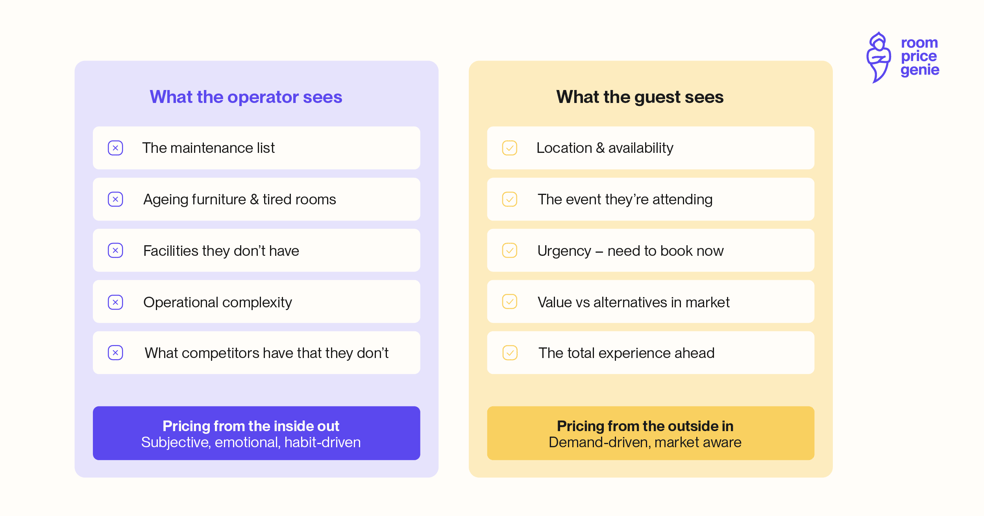
Accomodation operators see the property every day. They see the maintenance list, the ageing furniture, the rooms that could use an update, the facilities they do not have, and the operational complexity behind the scenes.
Guests see something different. They see...
Location. Availability. Convenience. Timing.
-
The reason for their trip.
-
The event they are attending.
-
The urgency of booking.
-
The alternatives available in market.
-
The total experience, not just the physical asset.
That difference matters.
“It is important to remember, that a guest booking for a major event, a peak holiday period, a last-minute family trip, or a high-demand weekend may value the stay very differently from the person managing the property. The room, cabin or site may be physically the same as it was a week earlier, but the market conditions around it may be completely different”, according to Matt Rose.
That is one of the central realities of revenue management: the product may stay the same, but demand does not.
“It is important to remember, that a guest booking for a major event, a peak holiday period, a last-minute family trip, or a high-demand weekend may value the stay very differently from the person managing the property.
Matt Rose, RoomPriceGenie
Being full is not always the same as maximising revenue
For most operators, a full property feels like success. And in many ways, it is. Strong occupancy is a positive signal.
But the timing of that occupancy matters.
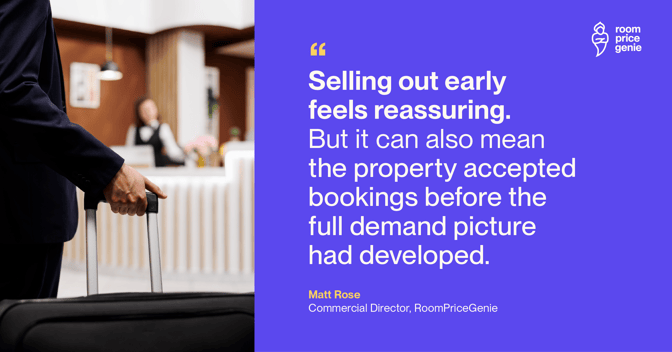
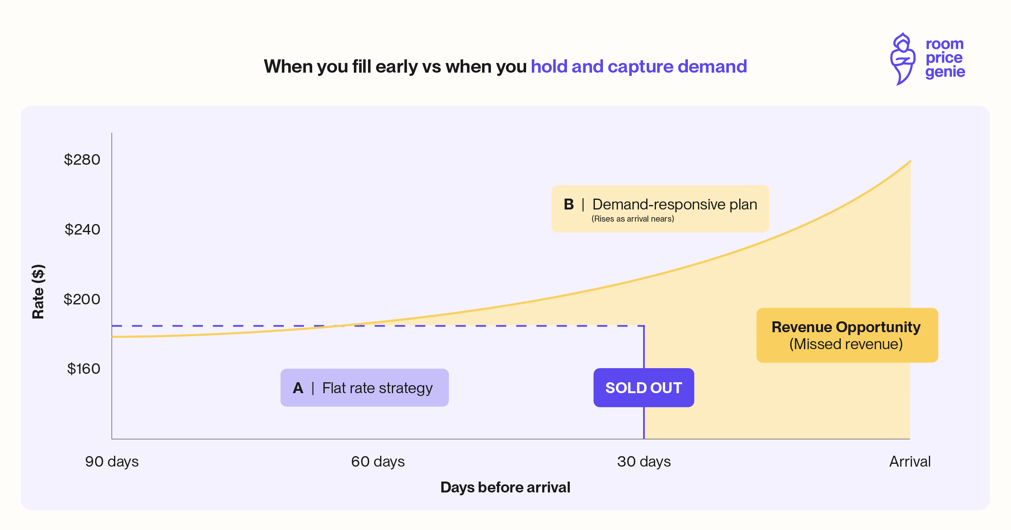
If a property is fully booked well in advance of arrival, it may be a sign that demand was stronger than the pricing strategy accounted for. That is a confronting idea for many operators, because selling out early feels reassuring. It removes uncertainty. It gives the team confidence that the rooms are booked and revenue is secured.
But it can also mean the property accepted bookings before the full demand picture had developed.
In accommodation, you can only sell the room once. Once that night is gone, the opportunity is gone with it.
As Matt Rose explains, “maximising revenue does not mean operators should always push rates higher. It means booking pace, lead time and demand patterns should be part of the pricing conversation and decision making process”.
Revenue management is not just about raising rates
One of the most common misconceptions about revenue management is that it is simply a way to increase prices.
That framing can make operators uncomfortable, particularly in independent, regional or family-owned accommodation businesses where guest relationships matter deeply.
But good revenue management is not about charging more every day. It is about making better decisions based on the demand in front of you.
“While revenue management is an art, it’s important to understand that sometimes it means increasing rates during high-demand periods. Sometimes it means holding firm rather than discounting too early. Sometimes it means reducing rates in softer periods to grow your fair market share based on reduced demand . Sometimes it means adjusting by day of week, room type, booking window, or market segment’ explains Matt Rose.
The goal is not higher prices at all costs. The goal is stronger commercial outcomes.
For one property, that may mean increasing ADR during peak periods. For another, it may mean improving low-season occupancy. For another, it may mean attracting more guests who spend in the restaurant, bar, activities, retail or onsite experiences. For another, it may mean reducing operational strain by focusing on higher-value bookings.
The right strategy depends on the property.
The metrics that matter depend on your business model
ADR and occupancy are useful starting points, but they are not the full story.
A property with high cleaning costs may think differently about occupancy than a property with low variable costs. A hotel with a restaurant may place higher value on additional guests because of the potential for ancillary spend. A holiday park may need to think about cabins, sites, annuals, long-stay guests and seasonal demand differently. A serviced apartment operator may care deeply about length of stay, account payments and operational efficiency.
This is why revenue strategy should not be separated from the operational reality of the business.
Two properties could achieve the same room revenue but have very different profit outcomes depending on staffing, cleaning, utilities, channel costs, guest spend and length of stay.
That is where a more thoughtful approach to pricing becomes valuable. Operators need to understand not just how much revenue they are generating, but what kind of revenue they are generating.
-
Are weekends carrying the business?
-
Are weekdays underperforming?
- Are peak periods being sold too early?
- Are low-demand dates priced too high?
- Are certain room types consistently undervalued?
- Are guests booking later than they used to?
- Are local events being picked up early enough?
These questions help move pricing beyond gut feel.
Data does not remove risk - it makes risk more calculated
Pricing will always involve some level of risk.
Raise rates too far and you may lose bookings. Drop rates too early and you may train the market to wait. Hold rates too long and you may miss occupancy. Fill too early and you may miss revenue.
There is no perfect price.
But there is a big difference between taking a blind risk and taking a calculated one.
“Ultimately, data-informed pricing helps operators understand what is changing and to respond with more confidence. It gives teams a clearer view of booking pace, demand patterns, occupancy, lead time, market conditions and historical performance” cites Matt Rose
Just as importantly, it helps operators act earlier.
A last-minute pricing decision is often a reactive decision. By the time the market has moved, the opportunity may already be reduced. Better visibility gives operators more time to make considered decisions rather than rushed ones.
The future is trusted automation, not blind automation
AI-driven platforms, along with automation will continue to influence revenue management. They will help operators analyse data faster, identify patterns, validate assumptions and surface opportunities that may otherwise be missed.
But pricing is sensitive.
“Tools like RoomPriceGenie, allow operators to understand what is happening. They allow owners the ability to retain control. They give operators more confidence. They provide flexibility to make pricing decisions that reflect their property, their market and their business goals” according to Matt Rose
That is why the future of pricing is not about handing everything over to technology without question.
It is about trusted automation.
The best systems will not remove the operator from the process. They will support better decisions, reduce manual work, highlight opportunities, and give teams the confidence to act when demand changes.
For independent properties, this distinction matters. Technology should not make operators feel like they are losing control of their business. It should help them feel more in control.
Closing the pricing confidence gap
The pricing opportunity for independent properties is not just about better rates. It is about better confidence.
✅ Confidence to challenge old assumptions.
✅ Confidence to respond when demand increases.
✅ Confidence to adjust when demand softens.
✅ Confidence to look beyond gut feel.
✅ Confidence to use data without losing the human understanding that makes independent hospitality so powerful.
Because many operators are not leaving revenue on the table through lack of care. They are leaving it behind because pricing feels uncertain, emotional and risky.
With better visibility, connected systems and smarter revenue tools, accommodation operators can make pricing decisions with more clarity and control - balancing guest experience, commercial performance and operational reality.
In a market where demand can shift quickly, booking windows can change, and guest behaviour is constantly evolving, pricing confidence is becoming a competitive advantage.
For independent properties, the opportunity is clear:
Do not price from fear.
Do not price from habit.
Do not price from guesswork.
Price with confidence.